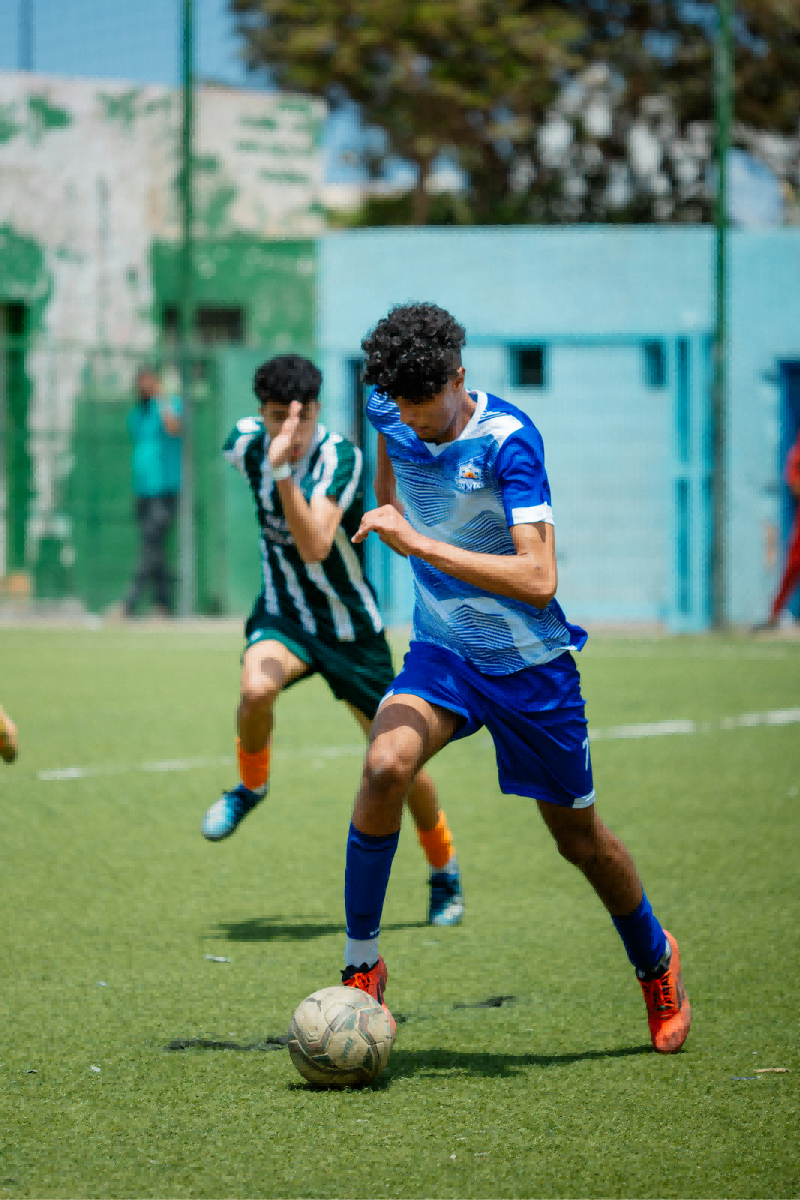
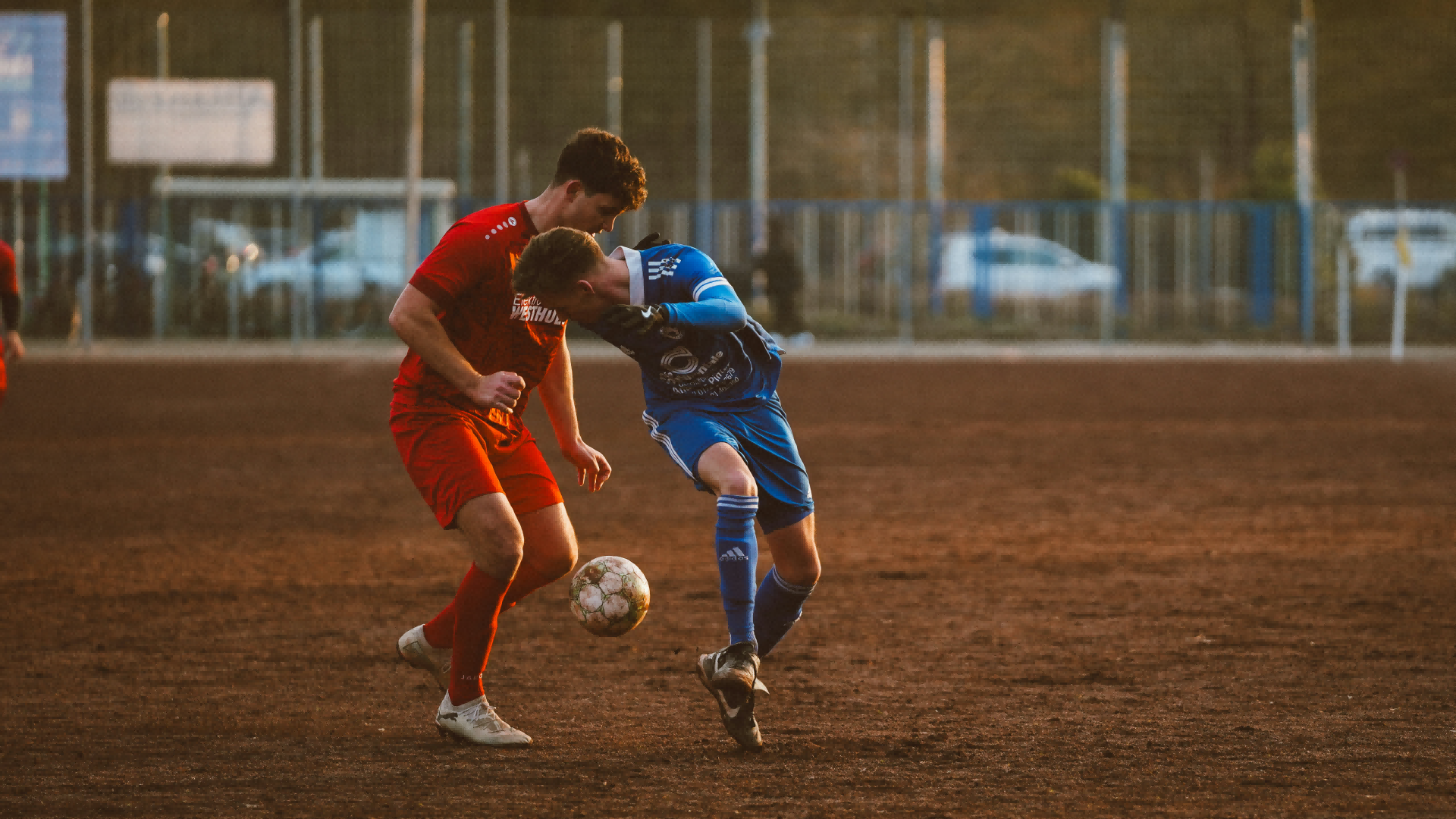
Football (or soccer) is the world's most popular sport, a team game where two sides of 11 players try to score by getting a ball into the opponent's net, primarily using their feet, head, or torso, but not hands or arms.
Besides 11-a-side, there are other more fields such as 5-a-side, 7-a-side, 9-a-side, futsal, walking football. Here we will take standard FIFA 11-a-side field as an example.

A standard football (soccer) pitch (field) is typically 105 meters long by 68 meters wide, as recommended by FIFA for professional matches, though dimensions can range from 90-120m long and 45-90m wide. International matches have stricter limits, often around 100-110m long and 64-75m wide, with UEFA using the 105m x 68m standard.

Figure 1 Dimensions for an 11-a-side football pitch
Each country or region has its own standards, and some international organizations also establish competition rules and lighting design rules. The primary standards referenced worldwide include :
(1). UEFA 2023
(2). FIFA 2020
(3). EN12193
(4). AS 2526
(5). RP-6-22
(6). JGJ 153-2016
We will take European EN12193 standards requirements as an example for reference.
DIN EN 12193 for sports lighting defines the minimum lighting requirements in tables for all sports.
Below is the basic requirements for non-broadcasting football fields:
| Class | E hor ave | U2 hor | Ra | Tcp | GR |
| Class I | 500lx | 0.7 | 70 | 4000K | 55 |
| Class II | 200lx | 0.6 | 60 | 4000K | 55 |
| Class III | 75lx | 0.5 | 60 | 4000K | 55 |
For venues not requiring broadcast-level television coverage, only horizontal illuminance need to be considered.
UEFA, The Union of European Football Associations, is the official governing body for football (soccer) in Europe and parts of Western Asia. Founded in 1954, it is one of FIFA’s six continental confederations, managing 55 national associations, organizing major tournaments like the UEFA Champions League, and controlling prize money and media rights.
Below is some basic requirements listed :
| Level | Eh ave | U1h | U2h | Ev ave | U1v | U2v | Ra | Tcp | GR |
| Elite Level A | >2000lx | >0.5 | >0.7 | ave>1500lx min>1000lx | >0.5 | >0.6 | ≥80 | 5000-6200K | <50 |
| Level A | >1500lx | >0.5 | >0.7 | ave>1250lx min:700lx | >0.4 | >0.5 | ≥80 | 5000-6200K | <50 |
| Level B | >1400lx | >0.5 | >0.7 | ave>1000lx min>600lx | >0.4 | >0.5 | ≥80 | 5000-6200K | <50 |
| Level C | >1200lx | >0.4 | >0.6 | ave>700lx min>350lx | >0.35 | >0.45 | ≥70 | 4200-6200K | <50 |
| Level D | >800lx | >0.4 | >0.6 | ave>350lx min>200lx | - | - | ≥65 | 4200-6200K | <50 |
Remarks: Due to UEFA required the same data for vertical 0°, 90°, 180°, 270°, just list one of them in the above format.
There are still more requirements for other factors, such as :
Maintenance factor MF : 0.9 for LED
Flicker factor FF : <3% for Elite Level A
Minimum adjacent uniformity ratio MAUR: >0.60 & ≤10 failures for Elite Level A
But different levels have different data.
FIFA, short for Fédération Internationale de Football Association, is the worldwide governing body for association football (soccer), futsal, and beach soccer. Founded in 1904 and headquartered in Zürich, Switzerland, it serves as the international regulatory body for the sport, managing 211 member associations and organizing major tournaments like the FIFA World Cup.
Below are some basic requirements listed:
| Level | Eh ave | U1h | U2h | Ev ave | U1v | U2v | Ra | Tcp | GR |
| Level A | Min>1500lx Ave>2500lx | >0.5 | >0.7 | Min>1000lx Ave>1500lx | >0.5 | >0.6 | ≥80 | 5000-6200K | <50 |
| Level B | Min>1200lx Ave>2000lx | >0.5 | >0.7 | Min>650lx Ave>1000lx | >0.4 | >0.5 | ≥80 | 5000-6200K | <50 |
| Level C | Min>800lx Ave>1250lx | >0.4 | >0.6 | Min>350lx Ave>700lx | >0.35 | >0.45 | ≥70 | 4200-6200K | <50 |
| Level D | >1000lx | >0.4 | >0.6 | Min>250lx Ave>400lx | >0.35 | >0.45 | ≥70 | 4200-6200K | <50 |
Remarks: Due to FIFA required the same data for Vertical 0°,90°,180°,270°, just list one of them.
There are still more requirements for other factors, such as :
Maintenance factor MF : 0.9 for LED
Flicker factor FF : <1% for Level A
Minimum adjacent uniformity ratio MAUR : >0.6 & ≤ 10 failures for Level A
and more details.
Typically, there are 3 lighting arrangement for football fields: two-side poles placement, four-corner poles placement, and hybrid. Hybrid lighting arrangement is usually for a broadcasting level.
This is guidance principles for 2-side poles placement:

This is guidance principles for 4-corner poles placement:

This is guidance principles for fixture locations on the side walkways:

Since each venue is designed independently without a standardized placement for lighting fixtures, specific lighting designs must be tailored to each individual situation.
When providing lighting design solutions, we must first determine whether television broadcasts are required, as lighting specifications for televised events are significantly more stringent.
The primary distinction lies in the fact that for venues without television broadcasts, we need only consider horizontal illuminance. However, for venues with television broadcasts, our primary focus shifts to vertical illuminance. This difference results in significant variations in the lighting design solutions required for each scenario.
According to EN12193 requirements, Class I target average lux is above 500lx, for this level usually there are 2 lighting poles placement, 2-side or 4-corner, Due to variations in the luminous efficacy of each product, the following simulation is for reference only.
Solution 1 : 500lx 2-side 6 poles
Pole arrangement: 2-side
Pole Qty: 36 nos
Pole height: 18m
Wattage: 1500W x 36 nos, total 54KW, with higher-efficiency luminaries, lower wattage needed.

Solution 2 : 500lx 4-corner 4poles
Pole arrangement: 4-corner
Pole Qty: 4 light towers
Pole height: 35m
Wattage: 1500W x 40 nos, total 60KW, with higher-efficiency luminaries, lower wattage needed.

Below is an AGI32 simulation for Class II targeted 200lx average only for reference:
Pole arrangement: 2-side
Pole Qty: 4 poles
Pole height: 18m
Wattage: 1000W x 20 nos, total 20KW, with higher-efficiency luminaries, lower wattage needed.

Below is an AGI32 simulation for Class III targeted 75lx average only for reference.
Pole arrangement: 2-side
Pole Qty: 4 poles
Pole height: 18m
Wattage: 600W x 16 nos, total 9.6KW, with higher-efficiency luminaries, lower wattage needed.

The sports flood lights available on the market can generally be divided into two categories: one is retrofit 1-to-1 type, typically designed with a one-piece heat sink, and the other is modular designed type, typically from 300W to 600W per module.
The design concept of R5 is to replace traditional HID one-to-one when refurbishment, particular attention should be paid to weight and dimensions.
There are 2 models which is designed with a one-piece heat sink, just different shapes. R5 is round while M6 is rectangular in shape.
R5 has 3 different sizes: 600-800W, 800W-1200W, 1200W-1500W
M6 also has 3 different sizes: 750W, 1000-1200W, 1500W
If the heat sink is used ACD12 die-casting alloy, the size and weight would be substantial, far exceeding that of traditional metal halide lamps, if maintaining the same dimensions would result in worse heat dissipation. Therefore, we employ a more reliable solution, using AL1060 cold-forging alloy.
| Model | Wattage range | Features |
| R5 | 600W-800W 800W-1200W 1200W-1500W |
|
| M6 | 750W 1000W~1200W 1500W |
|
There are a few modular designed Sports Flood lights in the market, from 300W to 600W per single module. Because it is more flexible and less tooling investments.
| Model | Wattage Range | Features |
| M5 | 500W single module | ADC12 Die-casting |
| M8 | 800W single module | ADC12 Die-casting, M8 is larger in size and heavier in weight than M5 |
| M4 | 600W single module | Body material: AL1060 Cold-forging, M4 has better heat dissipation abilities than M5 and M8, hence, M4 can be more compact under the same wattage comsuption which is very important for sports floodlights because of less EPA |
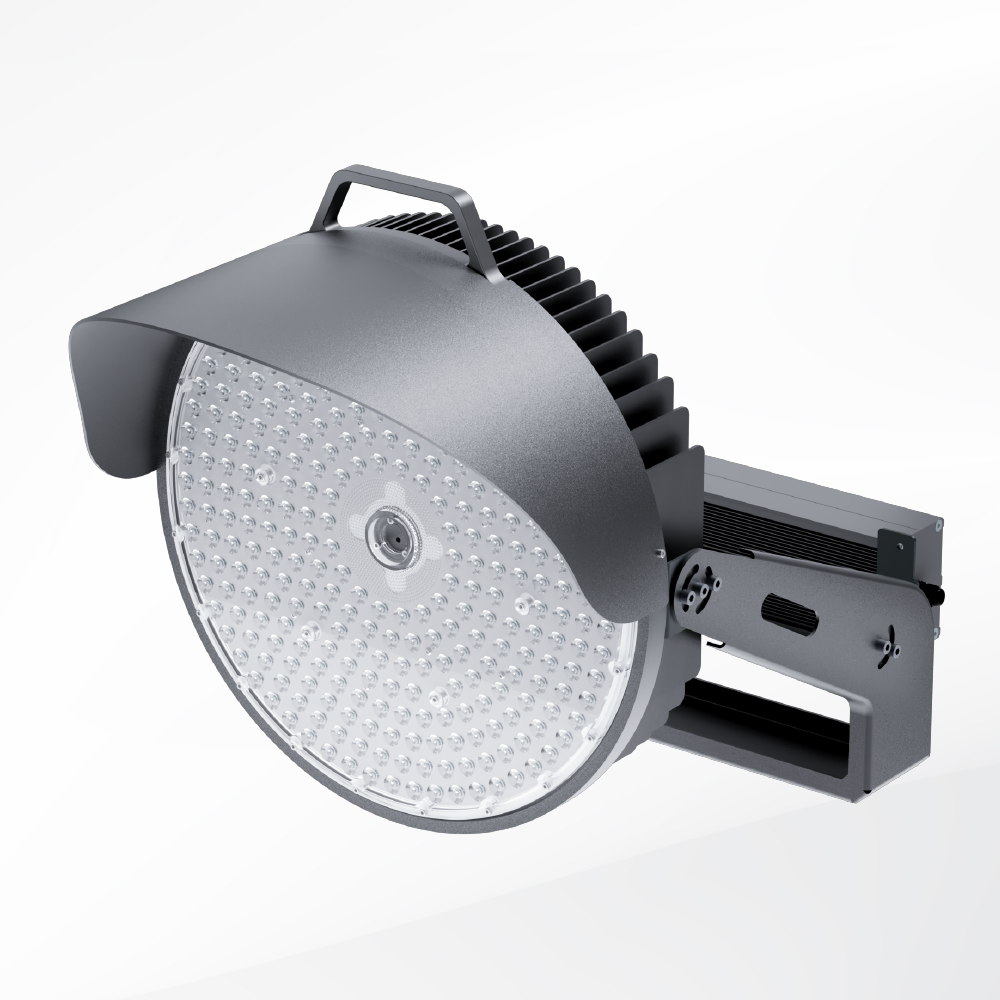
R5 1500W
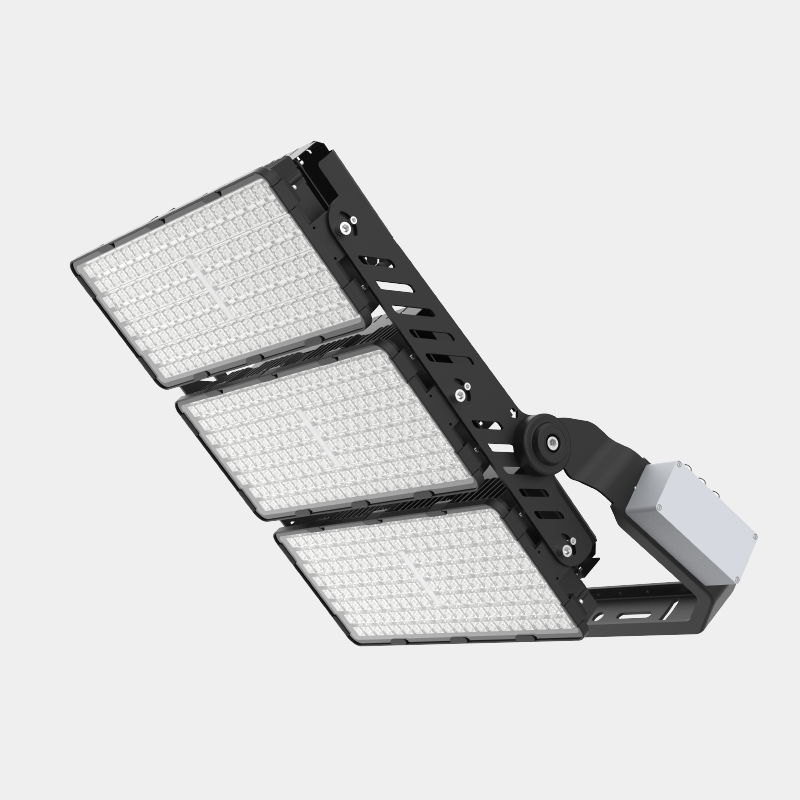
M8 1500W
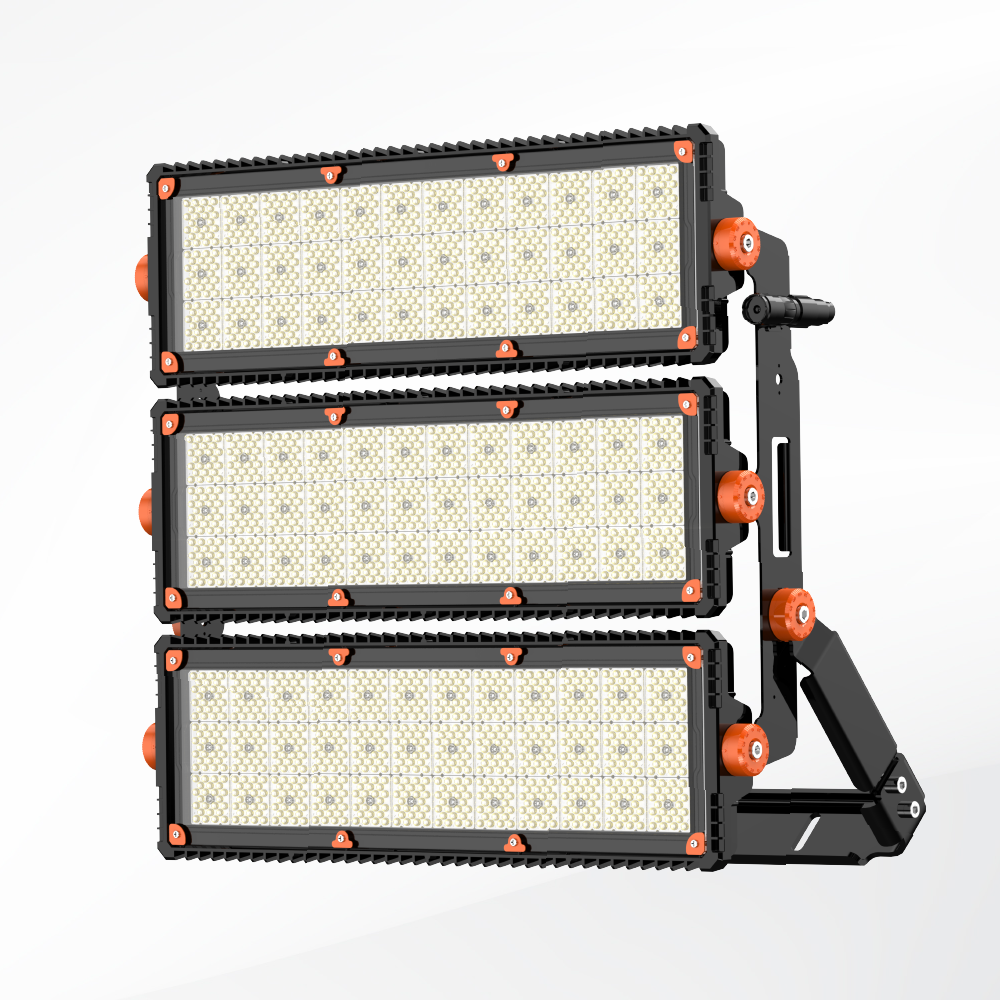
M5 1500W