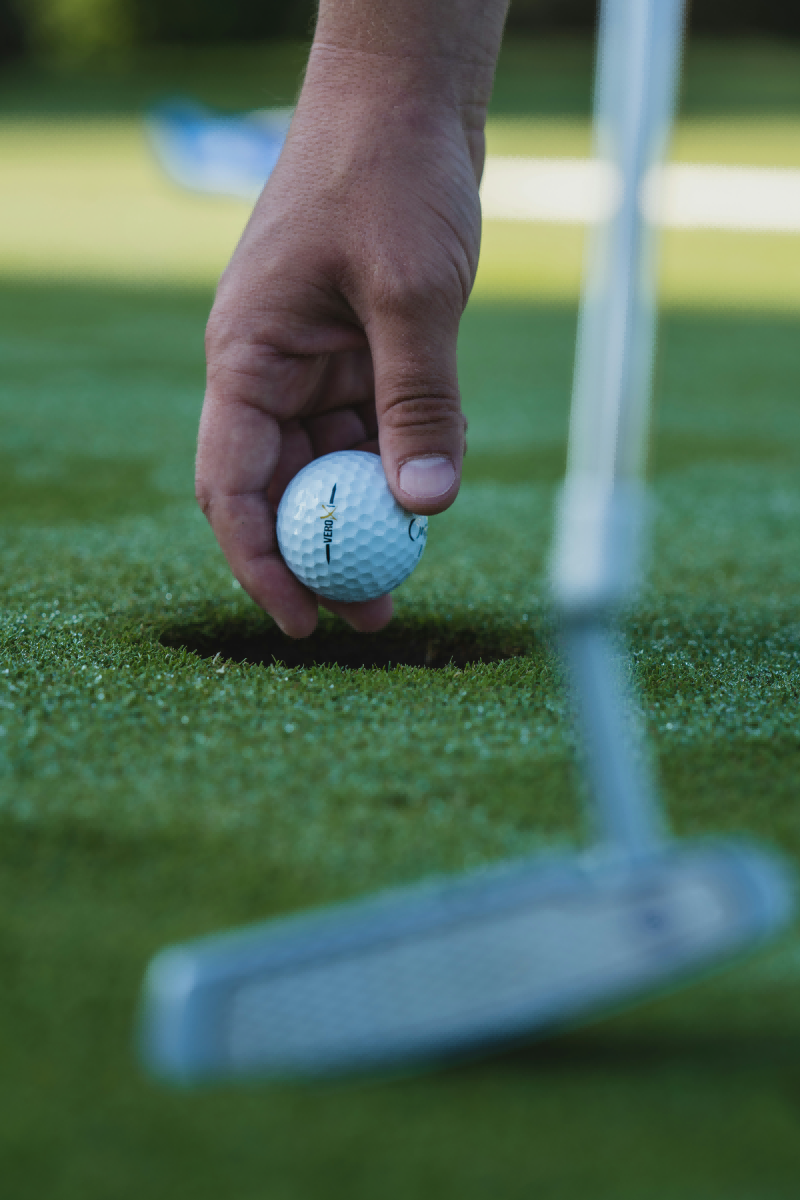
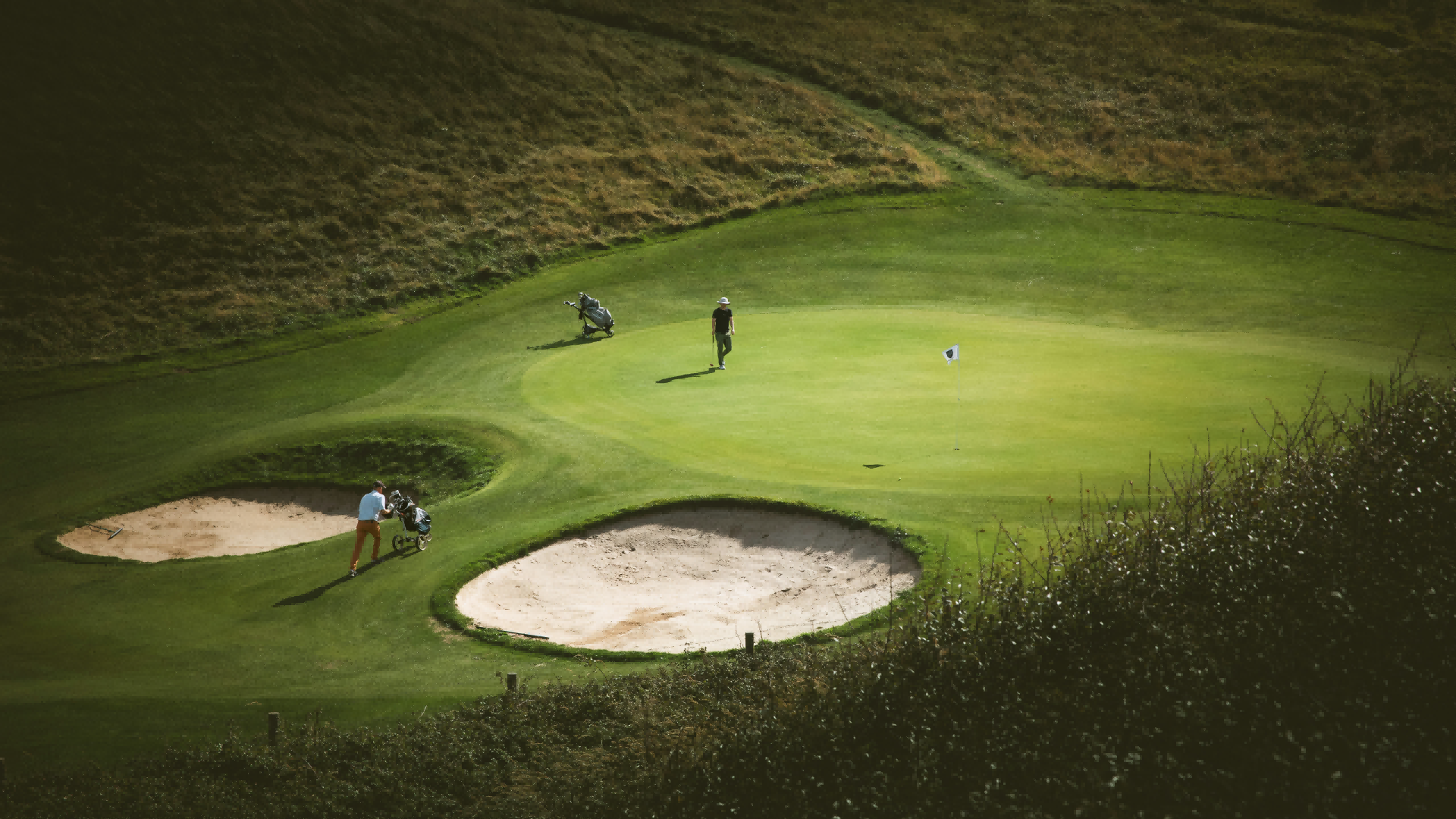
Golf is a precision club-and-ball sport where players aim to hit a ball into a series of holes (usually 9 or 18) in the fewest strokes possible, generally on an outdoor course. Originating in the 15th century Scotland, it requires skill, strategy, and etiquette, with players using various clubs to navigate obstacles like bunkers and water hazards.

Golf is a precision club-and-ball sport where players aim to hit a ball into a series of holes (usually 9 or 18) in the fewest strokes possible, generally on an outdoor course. Originating in the 15th century Scotland, it requires skill, strategy, and etiquette, with players using various clubs to navigate obstacles like bunkers and water hazards.
Most golf courses are unique and feature either 9 or 18 holes. Typically, golf is played on an 18 holes course. Each hole has its "par", which is the number of tee shots (drives), fairway shots, chips (short hits as you approach the green), and putts.
The par number is based on the length and difficulty of the hole. Pars range from 3 to 6. if you get the ball in the hole in 5 shots on a par 5 hole, you "made par". if it took you 6 shots, it's called a bogie, if you made it in 4, it's a birdie.

A typical 72-hole tournament consists of the following :
4 x Par3 : length < 229m
10 x Par4 : length between 229.1~430.9m
4 x Par5 : length above 431m
Standard configuration: 4 par-3 homes, 10 par-4 holes, 4 par5-holes, total par 72.
Golf is fundamentally a unidirectional aerial sport. The playing is divided into three separate parts: tee box, fairway, and green. The sport includes recreational and televised professional levels of play, but nighttime play is limited to recreational levels.
Recommendations for lighting are to aid visibility for participants only.
Golf (including driving range)
| Class | Teebox | Teebox | Fairway | Faiway | Green | Green | Vert over fairway and green | GR | Ra |
| Ehor ave lx | U2 hor | Ehor ave lx | U2 hor | Ehor ave lx | U2 hor | at 1m height | |||
| Class III | 100lx | 0.5 | 20lx | 0.3 | 50lx | 0.5 | 50lx | 55 | >60 |
For golf driving ranges the vertical illuminance only applies at the distance marker.
Recommendations for golf lighting are to aid visibility for participants only. Lighting for the fairway should be accomplished by luminaire locations on both sides of the fairway in order to provides spill lighting in the rough areas for errant golf shots. For narrow fairway(less than 2.0 pole mounting heights),the locations may be staggered to minimize the number of locations,but for wider fairways(greater than 2.0 pole mounting heights), the locations will need to be opposite configuration.

All luminaires should be aimed forward, in the direction of play. Care should be taken to make sure that visors and other glare control accessories are applied as needed to reduce glare to players on adjacent holes.
Each golf green should be lighted from two opposite sides to reduce players shadowing of the ball, while putting with the luminaire locations forward to the centerline of the green by at least 15 degrees and no more than 55 degrees.

This is a for driver range

This typical

The sports flood lights available on the market can generally be divided into two categories: one is retrofit 1-to-1 type, typically designed with a one-piece heat sink, and the other is modular designed type, typically from 300W to 600W per module.
The design concept of R5 is to replace traditional HID one-to-one when refurbishment, particular attention should be paid to weight and dimensions.
There are 2 models which is designed with a one-piece heat sink, just different shapes. R5 is round while M6 is rectangular in shape.
R5 has 3 different sizes: 600-800W, 800W-1200W, 1200W-1500W
M6 also has 3 different sizes: 750W, 1000-1200W, 1500W
If the heat sink is used ACD12 die-casting alloy, the size and weight would be substantial, far exceeding that of traditional metal halide lamps, if maintaining the same dimensions would result in worse heat dissipation. Therefore, we employ a more reliable solution, using AL1060 cold-forging alloy.
| Model | Wattage Range | Features |
| R5 | 600W~800W 800W~1200W 1200W~1500W | One-piece AL1060 Cold-forging heat sink with up to 237W/(m.K) standard thermal conductivity coefficient, which is double higher than ADC12 die-casting, which only has 96W/(m.K) |
| M6 | 750W 1000W~1200W 1500W | One-piece AL1060 Cold-forging heat sink with up to 237W/(m.K) standard thermal conductivity coefficient, which is double higher than ADC12 die-casting, which only has 96W/(m.K) |
There are a few modular designed Sports Flood lights in the market, from 300W to 600W per single module. Because it is more flexible and less tooling investments.
| Model | Wattage Range | Features |
| M5 | 500W single module | ADC12 Die-casting |
| M8 | 800W single module | ADC12 Die-casting |
| M4 | 600W single module | Body material: AL1060 Cold-forging, M4 has better heat dissipation abilities than M5 and M8, hence, M4 can be more compact under the same wattage comsuption which is very important for sports floodlights because of less EPA |
M5 is more economical than M8, while M4 has better heat dissipation management abilities due to AL1060 heat sink.
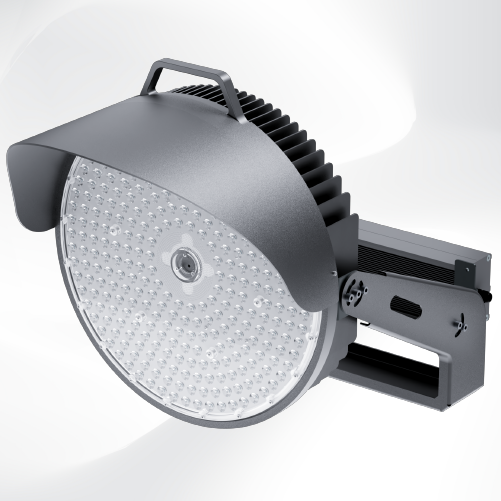
R5 1500W